The Associated Press: 56-nation Internet review shows wide differences
(AP) – 08.07.2011
VIENNA (AP) — An international review showing wide variances of Internet freedom gives Finland the best marks for making citizens’ access to a broadband connection a legal right.
But the 225-page report also expresses concern about the level of blocking practices encountered in some of the 56 states of the Organization for Security and Cooperation in Europe.
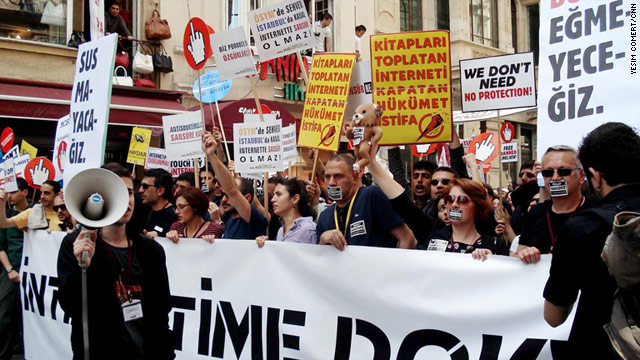
The report, published Friday, notes that Turkey has decided to introduce a mandatory Internet filtering system effective Aug. 22.
It said this would be the first such restriction within the OSCE region, which encompasses Europe, Russia, North America and central Asian states.
The report was presented at OSCE headquarters in Vienna.
08.07.2011
VIENNA, 8 July 2011 – The Internet should remain free and access should be considered a human right, said the OSCE Representative on Freedom of the Media Dunja Mijatović at the presentation of a report on regulations affecting new media in the OSCE region today.
The study, commissioned by the office of the Representative and authored by Yaman Akdeniz, a professor at Istanbul Bilgi University, measures the level of Internet content regulation in the OSCE area and assesses national laws in light of OSCE commitments and international standards of free expression and access to information.
The Study on legal provisions and practices related to freedom of expression, the free flow of information and media pluralism on the Internet is the first ever OSCE-wide review of laws regulating the Internet. Mijatović said the rapid development of Internet technologies and growth in user numbers were factors that inspired the report, which offers recommendations on how to keep the Internet open.
‘We will use the study as an advocacy tool to promote speech-friendly Internet regulation in the OSCE participating States,’ Mijatović said. ‘Some governments already recognize access to the Internet as a human right. This trend should be supported as a crucial element of media freedom in the 21st century.’
The study found that some participating States had problems submitting information for the study because legal provisions or relevant statistics were not easily retrievable. It also emphasizes that this lack of clarity makes it difficult for users to understand Internet regulation regimes.
Akdeniz expressed concern about the level of blocking practices encountered in the OSCE region. ‘Restrictions to freedom of expression must comply with international norms. No compliance could lead to censorship,’ he said.
The Representative highlighted other key trends revealed in the survey. ‘Legislation in many countries does not recognize that freedom of expression and freedom of the media equally apply to Internet as a modern means of exercising these rights and in some of our states, ‘extremism’, terrorist propaganda, harmful content and hate speech are vaguely defined and may be widely interpreted to ban speech types that Internet users may not deem illegal,’ Mijatović said.
The study argues that filtering and blocking measures are in most cases incompatible with freedom of expression and the free flow of information, both of which are basic OSCE commitments.
It is also a concern that several countries allow for complete suspension of Internet services at times of war, in a state of emergency and in response to other security threats, added Mijatović.
VIENNA, 6 July 2011 – Dunja Mijatović, the OSCE Representative on Freedom of the Media, will hold a news conference on Friday, 8 July, to present a new study on government efforts to regulate the Internet in the OSCE area.
The study, commissioned by Mijatović’s office, indicates that OSCE participating States are increasingly regulating content on the Internet. It argues that access to the Internet is a basic prerequisite for exercising the right to freedom of expression and the right to impart and receive information, and offers recommendations designed to maintain freedom of expression and the media on the Internet.
The OSCE 56 OSCE participating States created the Representative on Freedom of the Media institution in December 1997 to observe media freedom related developments in the OSCE region and to warn of violations of freedom of expression.
Journalists are invited to a news conference with the Representative and the author of the study, Yaman Akdeniz, a Professor of Law at Istanbul Bilgi University’s Faculty of Law, at 11 a.m. on Friday, 8 July, in room 201 of the Hofburg Congress Centre.
“
ARTICLE 19 – 10 September 2010
WikiLeaks and Internet Disclosures
The current debate around WikiLeaks highlights the potential of the internet to make previously secret information of public interest widely available. ARTICLE 19 calls for governments to improve their regimes for public access to information, refrain from punishing WikiLeaks and other sites that are releasing information in the public interest, and to protect and encourage whistleblowers.
ARTICLE 19 welcomes the use of the internet by new and established organisations as a mechanism to expand and democratise the availability of sources of information. We believe that this represents a powerful extension of the media’s role to receive information from confidential sources and make it available to the public.
The recent debate around WikiLeaks and the disclosure of secret US government documents related to the Afghan War Diary and Baghdad airstrike video underscores the need for strong legal rights to be in place in all countries for the public to seek, receive and impart information as guaranteed by the Universal Declaration of Human Rights and other international, regional and national human rights instruments. This includes recognition of the right to information, protection of whistleblowers, and facilitating the media’s ability to obtain and publish information without barriers.
It should be recognised that WikiLeaks is not the only site on the Internet that provides a forum for whistleblowers. Other sites, including Cryptome.com
ARTICLE 19 believes that the Johannesburg Principles on National Security, Freedom of Expression and Access to Information, developed by a group of experts and endorsed by the UN Human Rights Commission, is a proper starting point for evaluating concerns related to national security information in the Wikileaks debate. Moreover, we identified the following issues that must be considered in ensuing that the public’s rights under international law are respected:
1. Ensuring the Public’s Right to Information
It is well established that the right of the public to information held by government bodies is essential in ensuring democracy. Over 90 countries have adopted laws that guarantee that right and it has been recognised in international agreements including the UN Convention against Corruption, the UNECE Convention on Access to Information, Public Participation, and Access to Justice in Environmental Matters, and by many international bodies including the UN, Council of Europe, African Union and the Organisation for American States.
However, while there has been a significant increase in laws and other instruments guaranteeing the public’s right to information around the world in recent years, access to information is still inadequate in many counties, even those such as the United States with its long history of right to information. This is particularly a problem in the area of information classified as ‘state secrets’.
Under international law, governments must show that any restrictions on access to information are prescribed by law and necessary in a democratic society to protect a national security interest. Limits on access to information should only apply to information that governments can demonstrate would cause a specific and articulated harm.
The rules should not be used to hide other interests. Indeed, the existing US rules on secrecy prohibit classifying information about crimes and as a means to prevent embarrassment. Those rules are ignored far too often.
A number of military logs in the Afghan War Diary and the Baghdad airstrike video footage appear to demonstrate attacks on civilians by coalition forces which might amount to violation of the Fourth Geneva Convention. Full official disclosure of information about the allegations of ill treatment of civilians by the coalition forces in Afghanistan and Iraq would allow light to be shed on what has occurred. It would also enable a transparent and fair judicial review. Hence, the Baghdad video and much of the material in the Afghanistan War Diary should have been subject to mandatory disclosure under access to information laws in the respective countries of coalition governments, where, again, the overall public interest should trump secrecy exceptions.
2. Prosecution of Web Sites for Releasing National Security Information
There has been considerable discussion about the possible prosecution of WikiLeaks founder Julian Assange and other WikiLeaks activists under state secrets or espionage legislation in the United States or other countries. ARTICLE 19 believes that this would be an improper use of these laws and urges all governments to refrain from taking this step.
The statements of defence and state officials, calling for or warning of prosecution, might amount to censorship of media at a time and on issues – the war in Iraq and Afghanistan -– where transparency and the public right to know should govern the government’s relationships with the media and the public.
Moreover, it is a well established principle that public authorities bear sole responsibility for protecting the confidentiality of official information. Other persons and entities, including WikiLeaks and journalists, should never be subject to liability for publishing leaked information, unless it was obtained through fraud or another crime.
3. Protection of Whistleblowers
ARTICLE 19 also believes that those who provide information to WikiLeaks should not be prosecuted if there is a strong public interest in the release of the information.
Officials who act as whistleblowers and release information in the public interest without authorisation should not be prosecuted for releasing information that reveals crimes, abuses, mismanagement and other important issues in the public interest. Although we recognise that civil servants may legitimately be placed under obligations of secrecy, these should be limited by their obligation to serve the overall public interest. Anyone disclosing classified information should benefit from a public interest defence whereby, even if disclosure of the information would cause harm to a protected interest, no liability should ensue if the benefits of disclosure outweigh the harm. Instead, there should be strong legal protections and structures to facilitate disclosure.
Countries should adopt comprehensive whistleblowing laws which apply to the public and private sector and apply in national security cases. Secrets laws should recognise that whistleblowers should be protected from prosecution and should include public interest exemptions for revealing information such as human rights abuses and corruption.
Countries should also enact laws based on international standards protecting journalists from revealing their confidential sources and materials and those laws should apply to every person who is engaged in the business of making information available to the public.
4. Ethical Obligations of New Media
ARTICLE 19 believes that new media – including WikiLeaks and similar sites, should follow good ethical practices to ensure that the information made available is accurate, fairly presented and does not substantially harm other persons. While such ethical codes have not yet been developed for new media, we believe that existing journalistic codes provide a useful basis from which to begin.
Sites such as WikiLeaks should also recognise that technical protections to protect the anonymity of sources only have limited effectiveness. If the whistleblower is identified through other means, they can face serious employment and legal sanctions and even physical danger.
ARTICLE 19 is not qualified to take a position on whether the release of all of the Afghan documents by WikiLeaks was appropriate in these terms. To date, no credible information has been made public that links the release of the information to the harm of any individual.
Recommendations:
ARTICLE 19 therefore recommends:
• The governments of coalition forces and other states should refrain from criminal investigation and prosecution of WikiLeaks activists for the publishing of the materials on Iraq and Afghanistan as well as their sources
• All states should adopt and properly implement right to information laws which recognise the public interest in disclosure of information. Restrictions on access for national security reasons should be strictly limited
• All states should adopt comprehensive whistleblower-protection laws
• State Secrets Acts should only apply to those public officials and others who have agreed to be subject to them. Journalists and publishers should not be liable under these laws for disclosing information of public interest. The laws should also include public interest defences for protecting whistleblowers
• Internet sites should follow good ethical practices in their reporting activities.
NOTES TO EDITORS:
• For more information, please contact David Banisar, Senior Legal Counsel, ARTICLE 19, at banisar@article19.org
• The Johannesburg Principles on National Security, Freedom of Expression and Access to Information, Freedom of Expression and Access to Information are available at
http://www.article19.org/pdfs/standards/joburgprinciples.pdf
A must read….
BBC News – Is it time to defend our rights?
Copyright is not the only thing that matters online, says Bill Thompson
John Young is a brave and tenacious man, an architect based in New York whose website, cryptome.org, has been a safe online repository for documents that someone, somewhere does not want published.
Four UK politicians charged for dodgy expenses: “
The Crown Prosecution Service has informed the Metropolitan Police that it intends to charge four politicians with accounting offences after the investigation into the expenses scandal.…
“
(Via The Register – Public Sector.)
Changes confirmed for data protection and freedom of information appeals: “People appealing against rulings by the Information Commissioner’s Office (ICO) will face a new tribunal structure from January next year. The Information Tribunal, which hears appeals on ICO rulings, will become part of a wider system.”
(Via OUT-LAW News.)
Gerard Damiano’s 4,800-Page FBI File Unearthed: “A 4,800-page FBI file on ‘Deep Throat’ director Gerard Damiano released to the Associated Press following a Freedom of Information Act request shows the lengths agents nationwide went in an attempt to prevent a shift toward the acceptance of erotic entertainment.”
(Via XBIZ.com | News & Articles.)
Press release – 486(2009)
Council of Europe Conference of Justice Ministers – Twelve Council of Europe member states sign the Convention on Access to Official Documents
Tromsø (Norvège), 18.06.2009 – Twelve Council of Europe member states today signed the Convention on Access to Official Documents (CETS n° 205), the first binding international legal instrument laying down a general right of access to official documents.
This new Council of Europe Convention is the first binding international legal instrument to recognise a general right of access to official documents held by public authorities. Transparency of public authorities is a key feature of good governance and an indicator of whether or not a society is genuinely democratic and pluralist, opposed to all forms of corruption, capable of criticising those who govern it, and open to enlightened participation of citizens in matters of public interest. The right of access to official documents is also essential to the self-development of people and to the exercise of fundamental human rights. It also strengthens public authorities’ legitimacy in the eyes of the public, and its confidence in them.
Belgium, Estonia, Finland, Georgia, Hungary, Lithuania, Montenegro (*), Norway, Serbia (**), Slovenia, Sweden and ‘the former Yugoslav Republic of Macedonia’ signed the Convention at the beginning of the 29th Conference of the European Ministers of Justice which is being held on domestic violence on 18 and 19 June in Tromsø. The convention will enter into force once it has been ratified by five states.
The Convention sets forth the minimum standards to be applied in the processing of requests for access to official documents (forms of and charges for access to official documents), review procedure and complementary measures. Limitations on the right of access to official documents are only permitted in order to protect certain interests like national security, defence or privacy.
Establishing a common basis of minimum standards, derived from the widely diverse experience and practice found within the Council of Europe’s 47 member States, the Convention has the flexibility required to allow national laws to build on this foundation and provide even greater access to official documents.
Secret emails reveal sexing-up of Iraq dossier: “
Opposition parties are today renewing calls for a proper investigation into the Iraq war because a Freedom of Information request has revealed senior officials were concerned about how the intelligence was presented.…
“
(Via The Register – Public Sector.)